1. Who is Sylvie Fleury?
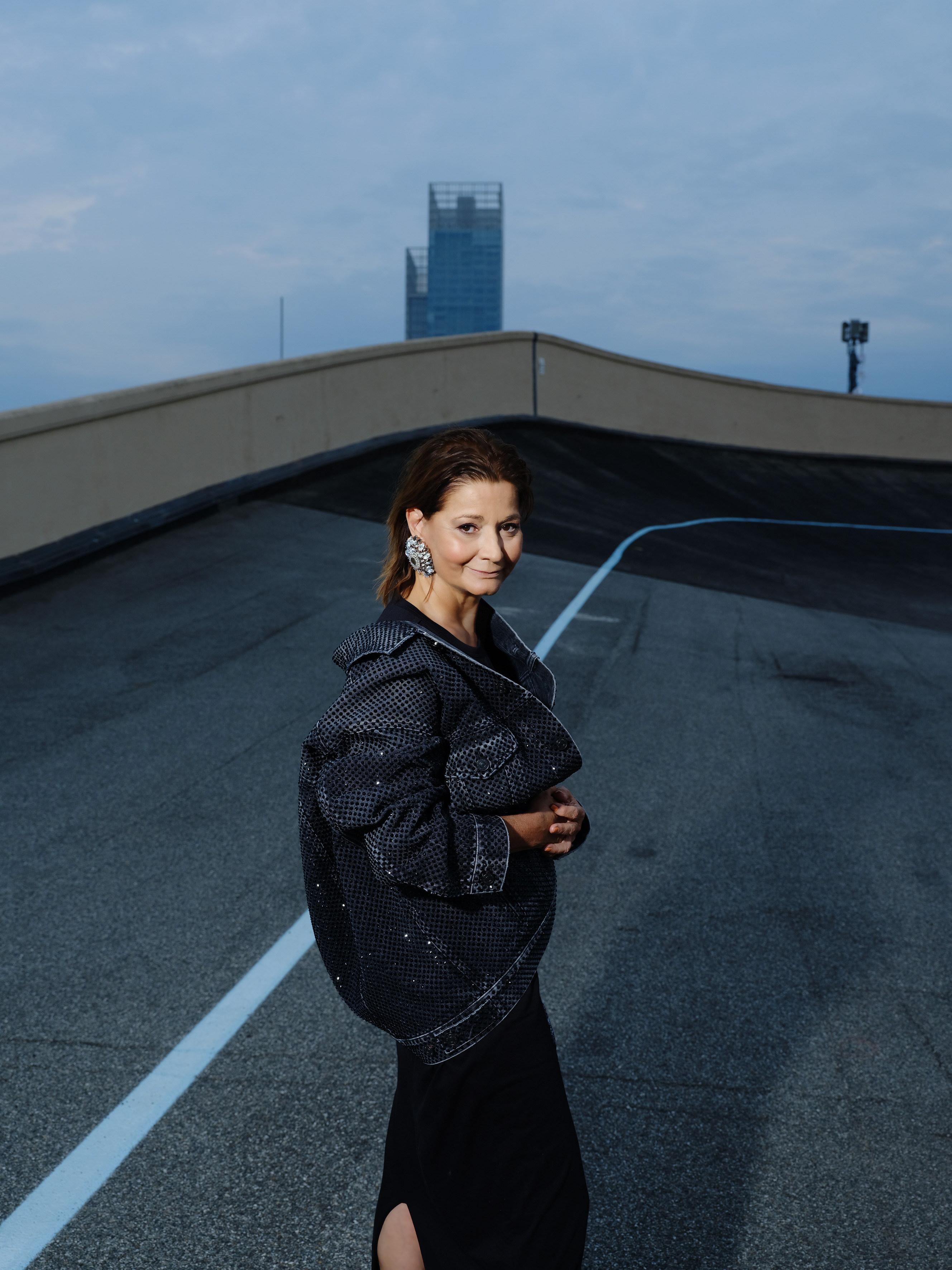
Sylvie Fleury (b. 1961) is one of the most prominent and internationally acclaimed artists of her generation. She lives and works in Geneva, Switzerland.
Fleury has inspired several Danish artists, including Tora Schultz, whose work The Devil’s Contract (2021) consists of a pair of red patent-leather stilettos placed inside a service lift. Their heels are shaped like pitchforks, referencing the poster for the film The Devil Wears Prada. The work is part of ARKEN’s collection.
Esben Weile Kjær has also been inspired by Fleury’s engagement with mainstream popular culture. In 2026, the two artists exhibited together at Andersen’s Contemporary in Copenhagen.
2. What is Sylvie Fleury best known for?
Sylvie Fleury’s artistic career spans more than three decades. She is best known for placing our relationship with capitalist consumer culture under scrutiny and exposing its stereotypical representations of gender roles, identities, beauty ideals and consumption – often on a monumental scale.
One of Fleury’s earliest iconic works is Shopping Bags, first created in 1990. After a shopping trip, she arrived at a gallery with her arms full of bags bearing the logos of major international luxury brands. She placed them on the floor and declared them a work of art – and so they became one.
Fleury has also created sculptures in the form of large, gleaming rockets, gold-plated shopping trolleys, glowing neon signs and XXL eyeshadow-palette paintings.
In the 1990s, Fleury founded a feminist motorsports club for motorcycles and cars called She-Devils on Wheels. The project plays with the stereotypes and symbols associated with traditional motor clubs, such as blazing flames. She-Devils on Wheels is a women-only social club for those who love customised American cars and motorcycles. It is also an art installation: a hybrid of a garage, fan club and merchandise shop that infiltrates the male-dominated world of motorsport with feminine elements—and asserts that women, too, can have high-octane fuel in their veins.
3. What characterises Sylvie Fleury’s artistic practice?
Sylvie Fleury works across a wide range of media. These include so-called readymades, such as shopping bags transformed into installations, as well as magazine covers that she alters through artistic interventions. She also works with bronze, neon, faux fur, luxury objects, cars, inflatable materials and much more.
Her choice of materials draws on post Pop Art, Minimalism and Conceptual Art while overturning the traditional hierarchies of art history. Her works explore the mechanisms that shape our desires and identities – without moralising. Fleury has a rare ability to combine critical reflection with immediate visual appeal.
Sylvie Fleury (born 1961 in Geneva) lives and works in Geneva.
Selected solo exhibitions include:
Mrac Occitanie, Sérignan (2025), Performa, New York (2025), Museum der Moderne Salzburg, Salzburg (2025), Kunsthal Rotterdam (2024), Kunstmuseum Winterthur (2023), Pinacoteca Agnelli, Aranya Art Center, and Bechtler Stiftung (all 2022), Kunstraum Dornbirn and Istituto Svizzero, Rome (both 2019), Villa Stuck, Munich (2016), Centro de Arte Contemporáneo, Malaga (2011), MAMCO, Musée d'art moderne et contemporain, Geneva (2008-2009), Mozarteum, Salzburg (2005), ZKM, Museum für Neue Kunst, Karlsruhe, and Le Magasin - Centre National d'Art Contemporain, Grenoble (both 2001), and Museum of Contemporary Art Chicago (1995).
Selected group exhibitions include:
Muzeum Sztuki Nowoczesnej / Museum of Modern Art, Warsaw (2025), National Museum of Modern Art, Kyoto (2024), Aspen Art Museum, Aspen (2024), Kunsthaus Zürich, Zürich (2023), Monnaie de Paris, Paris (2023), Migros Museum für Gegenwartskunst, Zürich (2022 and 2013), Jeu de Paume, Paris (2020), Grand Palais, Paris (2019), Kunsthaus Zürich (2018), Museum für Angewandte Kunst, Frankfurt (2017), Museum Haus Konstruktiv, Zürich (2016), Belvedere, Vienna (2012), Städtische Galerie im Lenbachhaus, Munich (2010), Chelsea Art Museum, New York (2007), PS1, New York (2006), Collection Lambert, Avignon (2003), and Museum Ludwig, Cologne (2000).
The exhibition opens at Arken on 11.02.27.