What is Contemporary Art?
Hvad er samtidskunst egentlig og hvorfor er det så vigtigt? Det kan du blive klogere på her.

Group Therapy, ARKEN, 2024. Foto: David Stjernholm
Hvad er samtidskunst egentlig og hvorfor er det så vigtigt? Det kan du blive klogere på her.
ARKEN is a museum of contemporary art. A museum, because we not only exhibit art but also collect it for our permanent collection to preserve it for future generations, conduct research on it, and communicate it. This is the special responsibility we uphold on behalf of the Danish state so that current and future generations can see what was important to us in our time, meaning today. ARKEN is Denmark’s largest art museum that exclusively collects and exhibits contemporary art created from 1990 onwards.
Is contemporary art simply art created from the 1990s to today? It is not that simple, so let’s make a short story a bit longer... ARKEN’s collection of contemporary art is defined as it is because the museum opened in 1996. The collection’s age and history go hand in hand with the museum’s history. Naturally, art created three decades ago will not remain contemporary art forever - 100 years from now, there will be artworks in the collection that are 130 years old, and by that time, they will likely be described with different terms than ‘contemporary art.’ It is as paradoxical as how ‘modern art’ is no longer modern but now a period in art history.
Contemporary art is art created in the time we live in together. It reflects our own time, critically and curiously examining it, tasting it, chewing it, and spitting it out again in the form of new statements, expressions, and actions. Contemporary art can surprise us. It can massage and irritate our senses. And it can, like a mirror, show us images of ourselves and our reality, prompting us to question, discover, converse, understand each other, and move forward. Contemporary art can push boundaries and open doors to the future.
.%20Foto_%20Anders%20Sune%20Berg.jpg)
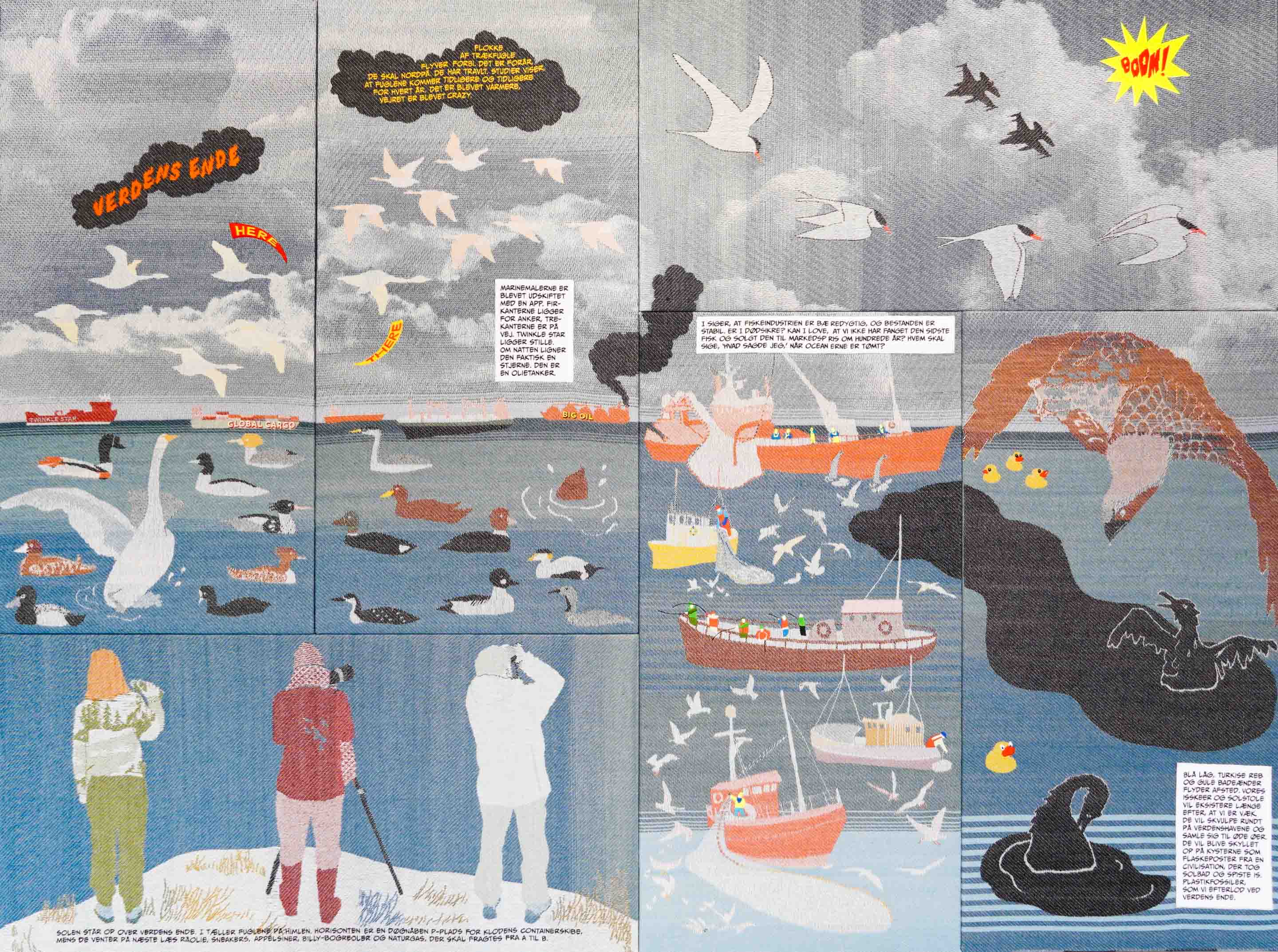
Simone Aaberg Kærn, Open Sky (2024). Photo: Anders Sune Berg
In Rasmus Myrup's practice, contemporary art becomes a space where history and identity can be reinterpreted. In Outside Salon de Refusés, visitors encounter seven mythological figures standing outside a nightclub that humans are not allowed to enter. The sculptures are both humorous and captivating, while also exploring queer narratives, power, and Nordic cultural history.
.%20Foto_%20Anders%20Sune%20Berg.jpg)
Rasmus Myrup, Outside Salon de Refusés (Installation view). Photo: Anders Sune Berg
Modern art and contemporary art are often confused, but they refer to different periods and different ways of understanding art.
Modern art emerged in the late nineteenth century and continued throughout much of the twentieth century. Artists such as Pablo Picasso and Henri Matisse broke away from traditional ways of painting and representing the world. They experimented with colour, form, and perspective, questioning what art could be.
Contemporary art builds on many of these experiments but is generally less concerned with fixed styles and more interested in ideas, experiences, and the issues shaping our world today. While modern art often focused on reinventing the language of art itself, contemporary art is more likely to investigate the realities and structures of contemporary society.
This is evident in Nina Beier and Bob Kil's performative work Life Guardians, in which five marble lions are accompanied by performers executing choreographed movements. The work explores the relationship between body, image, and power, using humour to challenge our assumptions about authority and control.
.%20Foto-%20Anders%20Sune%20Berg.jpg)
Nina Beier, Guardians (2023). Photo: Anders Sune Berg
.%20Museo%20Tamayo%2C%20Mexico%20City%2C%20September%202024.%20Foto_%20Ximena%20Fargas%20(1).jpeg)
Bob Kil, Life (2022). Museo Tamayo, Mexico City, September 2024. Photo: Ximena Fargas
Humour and critique are also central to Elmgreen & Dragset's iconic sculpture Powerless Structures, Fig. 101, located outside ARKEN. At first glance, the six-metre-tall boy on a rocking horse resembles a traditional equestrian monument. Instead of celebrating power and heroism, however, the sculpture honours imagination, playfulness, and vulnerability. In doing so, it turns familiar symbols upside down—an approach that characterises much of contemporary art.
.jpg)
Elmgreen & Dragset, Powerless Structures, Fig. 101, 2012. Photo: Henrik Jauert
Contemporary art therefore does not require viewers to "understand" a work in the correct way. What matters most is curiosity: What does this artwork do to me? What thoughts or emotions does it evoke?
Perhaps that is the defining quality of contemporary art: it does not provide ready-made answers but opens up new ways of seeing the world.
ARKEN is Denmark’s museum of contemporary art. We live and breathe to communicate contemporary art to everyone and to contribute to the development of the cultural heritage that will emerge over time. We explore new frontiers alongside artists to create an inclusive space where ideas can be shared, dialogues can take place, and breakthroughs can be made that advance both art and society. These are grand words. But when you step through the doors of ARKEN, we simply wish you fantastic, immersive, and thought-provoking experiences with contemporary art. Everything else will follow naturally.