OPEN SKY: Simone Aaberg Kærn
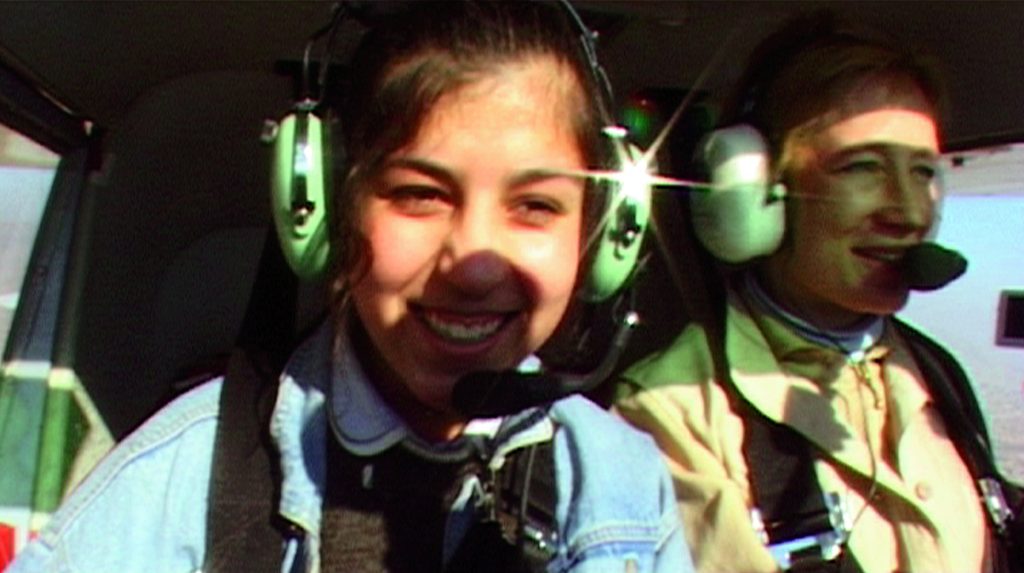
Simone Aaberg Kærn, Micro – Global Performance #4 (Farial Finally Flying), 2002. © Simone Aaberg Kærn
Simone Aaberg Kærn, Micro – Global Performance #4 (Farial Finally Flying), 2002. © Simone Aaberg Kærn
Simone Aaberg Kærn, Micro – Global Performance #4 (Farial Finally Flying), 2002. © Simone Aaberg Kærn
“Flying yourself is like having a smiling sun in your stomach,” says Simone Aaberg Kærn, as she sits in her small single-engine aircraft on her way to Afghanistan to meet the 16-year-old Farial. The journey begins with a newspaper article in Politiken, where Aaberg Kærn reads about the young Afghan women Farial and her dream of becoming a figther pilot. Aaberg Kærn wants to give Farial wings by creating a feminist air bridge and helping her get closer to her dream.
Through highly regulated and militarily controlled airspace, Aaberg Kærn flies from Lille Skensved, northwest of Køge, to Kabul in Afghanistan, risking her life. Her mission is a mission of freedom, in which she seeks to reclaim the air and the freedom of the sky. After the terrorist attacks of September 11, 2001, attacks, global airspace came under tightened control and military restrictions, making private flights for more difficult to carry out. With a smile and a firm insistence on the success of the mission, Aaberg Kærn and her then partner Magnus Bejmar make it safely to Kabul through heavily controlled airspace.
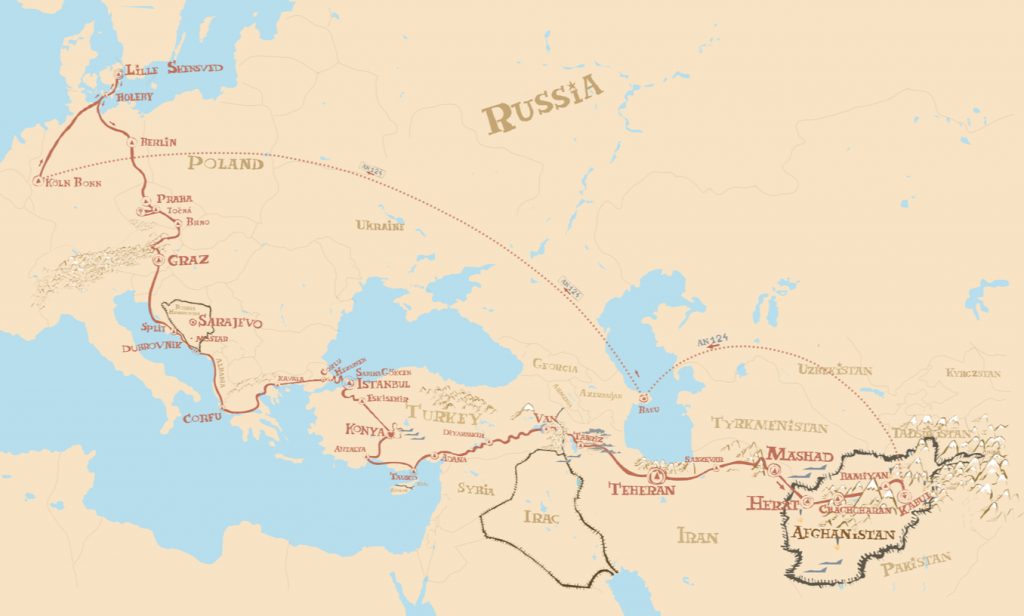
Digital map of the flight route from Lille Skensved, Denmark, to Kabul, Afghanistan. © Simone Aaberg Kærn
Simoen Aaberg Kærn’s nine-month performance Mikro Global Performance (2002-2003) is filmed and documented by Magnus Bejmar, and together they create the art film Smiling in a Warzone, which moves between reality and adventure with a clear artistic intention.
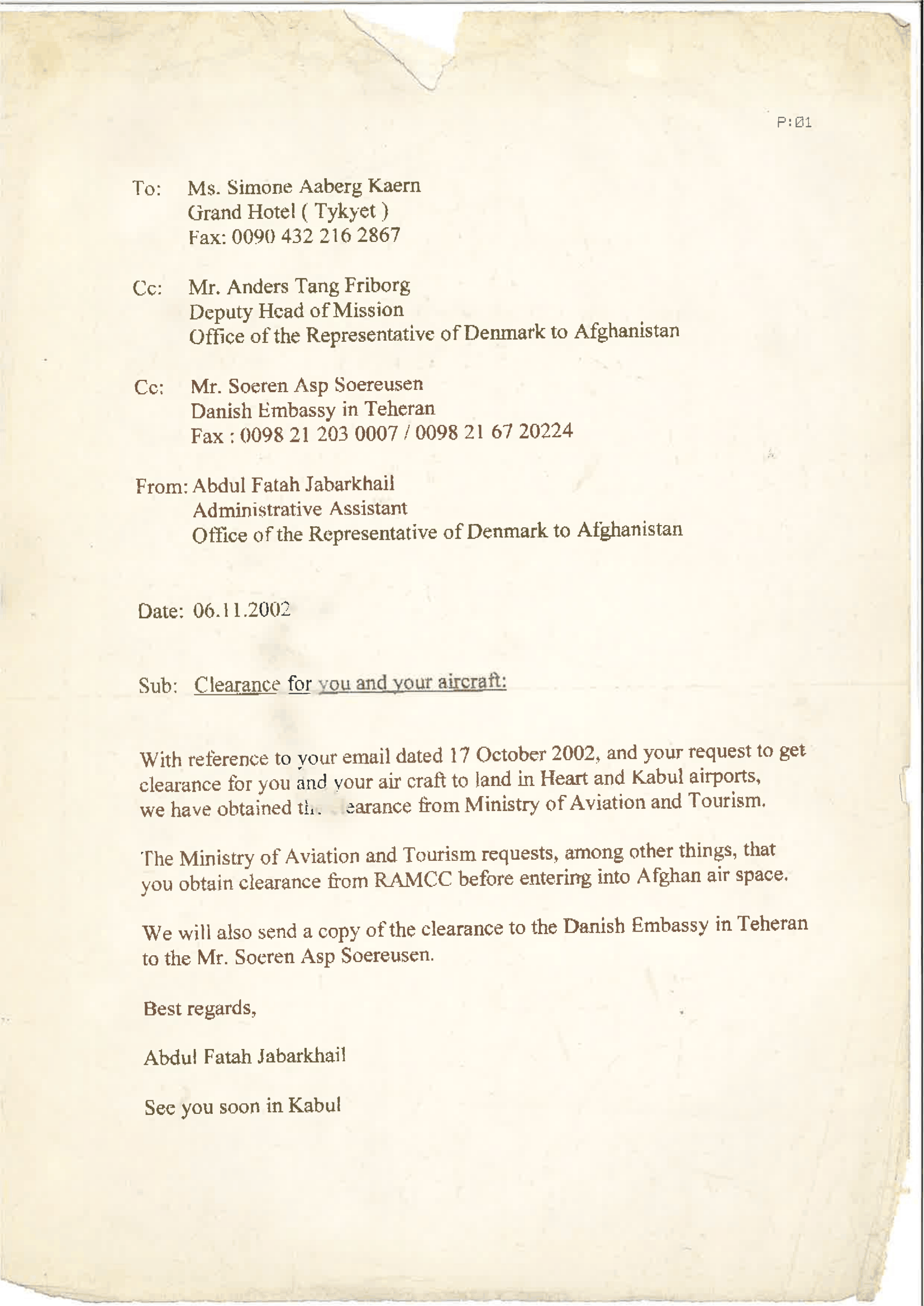
Negotiations. 6 November 2002. © Simone Aaberg Kærn
The negotiations above show the status of permission to enter Afghan airspace: a local permit form Afghanistan has been granted, but approvel from RAMCC, the American military air operations unit, is still missing. The many negotiations required to obtain permission to fly through militarily controlled airspace form a significant part of Aaberg Kærn’s project. They testify to the complex and nearly impossible process of gaining permission to cross national borders and military zones and thus navigating political and military power structures where the freedom of the sky is put to the test. Aaberg Kærn’s request to RAMCC for permission to cross Iran is denied, and she ultimately flies illegally through a war zone to reach Afghanistan.

© Simone Aaberg Kærn. Photograph by: Magnus Bejmar
During the journey, Aaberg Kærn discovers, despite her own assumptions, that female military pilots already existed in Afghanistan, including the two sisters Lailoma and Latifa, who are seen in the image.

© Simone Aaberg Kærn. Photograph by: Sonita Habib (Farials sister).
The image shows Aaberg Kærn, Farial, Farial’s mother, and Laura Beldimar. Aaberg Kærn met Laura Beldimar in Kabul and became a co-creator of the film Smiling in a Warzone. On the back of the photograph, Aaberg Kærn has written that she experiences a timeless sense of sisterhood.
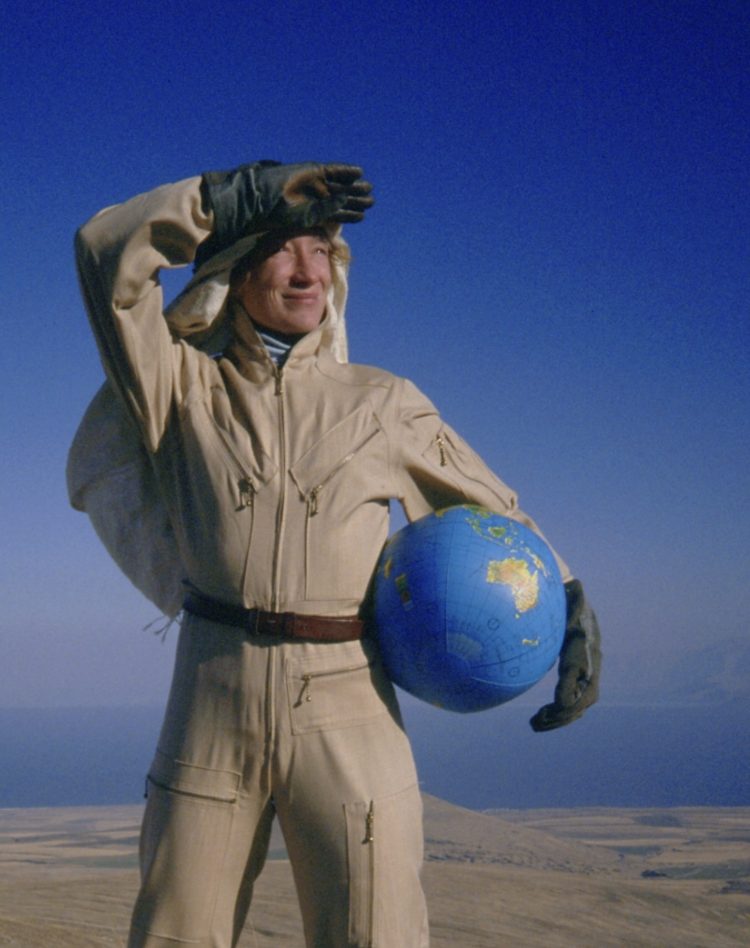
Simone Aaberg Kærn, Micro – Global Performance #1 Open Sky,2002. © Simone Aaberg Kærn. Photograph by: Magnus Bejmar.
Simone Aaberg Kærn challenges the conflict-ridden space of war through a vision of freedom. War is the diametrical opposite of freedom, but what happens when art enters the space of war? Even while situated within militarily controlled airspace, she creates a adventures project of liberation through her performative practice. With a flight suit, pilot’s cap, and an inflatable globe, she stages herself as both hero and protagonist, drawing on mythic and fairy-tale narratives of the sky, where flight functions as a symbol of freedom. With curiosity, optimism, fearlessness, and an almost dreamlike approach to the world, she uses naivety as a tool to carry out the mission
The fairy-tale approach in Aaberg Kærns’s performance can be compared to The Littel Prince. Like in The Littel Prince, she sets out into the world and encounters different people and cultures with a curious and open gaze, seeking to understand the unknown and the unfamiliar. The poetic figure is not merely innocent, but deeply political. Aaberg Kærn explores and employs a form of propaganda aesthetics in both her attire and rhetoric, adopting a critical and inquisitive stance toward the hero narrative.
The use of heroization carries a certain ambivalence, as Aaberg Kærn draws on a Western ideal of freedom, in which she may appear as someone seeking to help or enable the young Afghan woman’s dream. At the same time, she consciously employs her performative persona as a strategy for carrying out the project. The heroic narratives thus open up critical questions about freedom, representation, and the notion of the “good deed”.
Simone Aaberg Kærn’s art project Open Sky originates in her performance Micro-Global Performance, but has evolved in response to its contemporary context by actively engaging with the situation of women and girls in Afghanistan. In the recent work I Wish I Could... (2026), a banner trail behind the exhibited Piper Colt aircraft bearing the words of a 14-year-old Afghan girl written in Dari, her native language. Her words testify to how women and girls were abandoned when Denmark and other countries handed Afghanistan over to the Taliban. Through the luminous banner, Afghan women and girls are given the opportunity to speak within the work.
(English translation of the banner text)
I was breathing
I was studying
I had a future
In 2021
my dream broke
I am 14 years old
For five years now
At home
suffocating
The Taliban
They have closed the door
Air!
Air!
Air!
••• - - - •••
A message from a 14-year-old girl in Afghanistan, spring 2026.